

An expanded version of this piece was also published in The Free Press.
The Jewish community has been sounding the alarm about antisemitism for years, and youth antisemitism has become a fixture of that conversation. But as a high schooler, I can tell you the scale of it is far worse than any adult realizes.
This article focuses on a mainly right-wing phenomenon of youth antisemitism—not because it’s a bigger threat than antisemitism on the left, but because it’s newer, less understood, and far less discussed than left-wing antizionism. It’s a strain of antisemitism based on conspiracy theories, jokes, and social media, spreading especially among young men. It denies the Holocaust by joking about the seemingly impossible number of “cookies”—Jews—baked in “ovens,” and spreads conspiracies about AIPAC, Netanyahu, Epstein’s alleged ties to Mossad, and Jews engineering fast food to keep the “goyim” unhealthy. Among young men and teenage boys, it's shockingly widespread. Antisemitism has become the joke. And this phenomenon is starting to metastasize into an insurgent right-wing political movement that threatens to make the Republican Party the second to be consumed by Jew-hatred as an organizing principle.
One word captures this new form of antisemitism: goy. A Hebrew word used to refer to non-Jews, until recently, it was only used negatively by the darkest corners of the fringe far-right. In those corners the term carries the implication that Jews see non-Jews as subhuman cattle to be controlled. For example, a pro-Israel non-Jew might be called a “Goy Slave,” loyal to his Jewish overlords.
That was two years ago. Today, goy has migrated—through memes and TikToks—into the everyday vocabulary of young American men who in large part have no idea what it means. The chemistry teacher who gives too much homework might be called a goy. You would not blink hearing “you’re such a goy” in any context. Bad food is “goyslop”—and there are now TikToks with millions of views claiming that kosher-labeled food is healthier because Jews deliberately made non-kosher food into “goyslop” to keep non-Jews unhealthy, weak, and easier to control. The word traveled from the fringes, into every corner of social media, and from there into real life—so ubiquitous now that many people who jokingly use it don’t even know what it means.
For years, antisemitic comments and memes have been a predictable feature of social media conversations about Israel, 9/11, banking, the media, and countless other topics. But two things have changed. The first is scale: Holocaust denial, jokes about Jewish control, and every trope in between are now so pervasive across every corner of social media. The second is that this content has stopped staying online. These comments and memes have metastasized into real life, migrating fully into everyday conversation and becoming the communal joke among young men. Mention almost any topic and antisemitic jokes and conspiracies will come. Netanyahu—“Big Yahu,” as he is jokingly known—is memed and joked about more than any world leader. Tel Aviv is referenced more than any city. AIPAC more than any political group. There is no topic that is joked about as much, as constantly, and as casually as Jews.
And the scale of the terms, tropes, and jokes reflects this. Shekels are constantly joked about. “Promised to you 3,000 years ago” is a refrain—a joke about the Jewish claim to Israel being based only on a 3,000-year-old divine promise, now used as a joke in any context whatsoever.
Hava Nagila, an Israeli folk song, is more than ubiquitous on antisemitic social media posts and may be heard played on someone’s phone. The “Happy Merchant” meme—a caricature of a scheming, hand-rubbing Jew—circulates both online and is even mimicked by people themselves. Young men have developed a profoundly complex lexicon of antisemitism that has spread to a chilling degree.
Holocaust denial has become a recurring joke. Six million could not have died, a popular joke goes, because the ovens couldn’t have baked six million cookies fast enough. In at least two Canadian high schools, this and similar Holocaust denial tropes were printed as students’ yearbook quotes.
People stuck in traffic post TikToks that jokingly call on Bibi Netanyahu to take out bad drivers—and get billions of views. Antisemitic TikTok trends—like ultra-popular esoteric myths about an underground Aryan master race—have become scarily common and pervasive.
The word antisemitism, meanwhile, has been almost completely defanged. Being called antisemitic is itself a joke. The consensus has come to believe that the term has been so broadly applied against anyone critical of Israel that it has lost all meaning.
It helps that young men’s biggest role models make antisemitism feel less like a slur and more like a shared inside joke, or even a badge of honor.
Earlier this year, Nick Fuentes, Sneako, Myron Gaines, Clavicular, and Andrew Tate were at a club in Miami where they requested and live-streamed themselves singing along to Kanye West’s “Heil Hitler.” The lyrics: “All my n**s Nazis, n*a heil Hitler.”
The men in that video are among the most followed and influential figures in the lives of young American men today, and they all preach their own destructive ideologies, with antisemitism as the common thread running through all of it.
Clavicular was the odd man out though. While many of the other popular influencers are proud neo-Nazis, he is an up-and-coming, mainly non-political influencer—known primarily as a “looksmaxxer,” part of an online subculture obsessed with maximizing physical attractiveness. That an ascendant “apolitical” influencer is nonetheless singing “Heil Hitler” alongside some of the most famous male influencers today tells you antisemitism in these spaces isn’t just normalized—it’s become something you do to fit in.
Not only are these antisemitic jokes so commonplace, and the influencers who spout them so popular, but many young men really do believe them. Social media has convinced a frightening amount of young men that Jeffery Epstein was a Mossad agent, that JFK was killed by Israel, that Israel did 9/11, that Trump is owned by Israel (like all other politicians), and that Jews control the banks and media. People who have never read a history book can tell you about the Dancing Israelis on 9/11, the Israeli attack on the USS Liberty, the insurance policy on the Twin Towers, and the lack of air-tight doors on the gas chambers of Auschwitz. For a startling number of young men, the only thing they seem to know with any confidence about the world is that Jews control it.
And this antisemitism doesn’t exist in isolation—it is one piece of a much broader phenomenon that feeds conspiratorial thinking about everything from 9/11 to the legitimacy of America’s institutions and democracy itself. I wrote more about the causes of this and what the response should be in a version of this piece published by The Free Press.
On social media, antisemitism saturates every corner. In real life, Jew-hatred functions as the shared inside joke. And for a growing number of young men, the belief that Israel is an evil state that controls America and is the hidden hand behind the world’s problems has become their defining political conviction. It isn’t that this comes up sometimes—it’s that an entire generation of young men has become obsessed with the Jews in a way that borders on pathological, in a way that defies description. When I was talking to a friend about the rise of this antisemitism at school, he said: “It’s the whole school against you.”
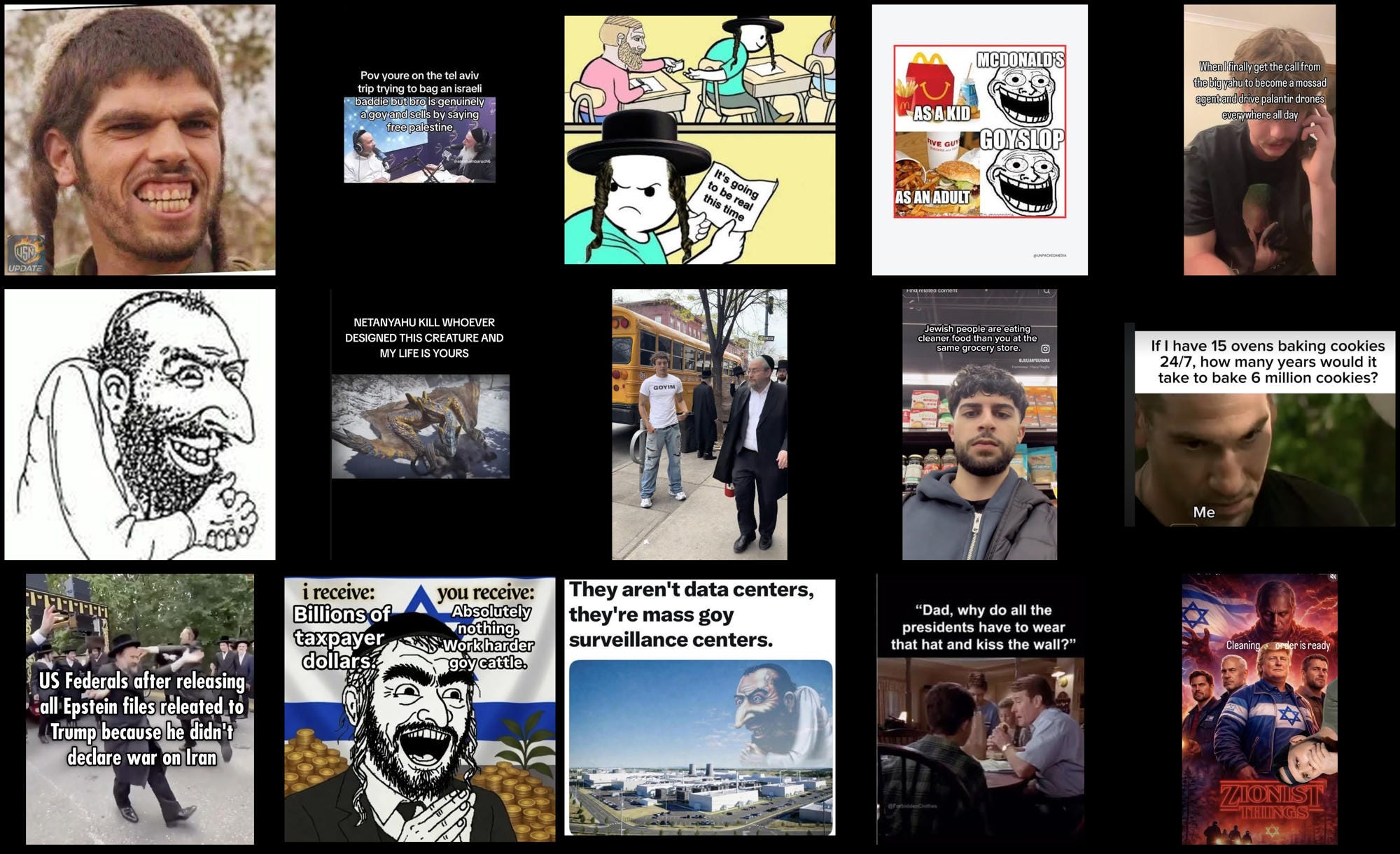
A Collage of Antisemitic Tiktoks
In many ways, the face of this explosion of antisemitism is Nick Fuentes—a 27-year-old streamer and political commentator who has spent the better part of a decade building an antisemitic right-wing political movement. He got his start in white nationalist and neo-Nazi milieus, attending the infamous Unite the Right rally in Charlottesville in 2017. He soon dropped out of college and began streaming from his parents’ basement, building a loyal following of young men called Groypers, named after a meme—people who would “rape, kill, and die” for Fuentes. He put that following to use, sending them to confront Ben Shapiro and other establishment conservatives at public events with pointed questions on Israel. Fuentes is also a Christian nationalist—“Christ is King” is his creed.
Fuentes was, for years, one of Trump’s most devoted supporters—until, in his telling, Trump betrayed the movement by continuing to serve Israel and Zionist interests rather than deliver on the “America First” agenda Fuentes believed he was elected to pursue.
In the past year or so, Fuentes has gone gangbusters; he is no longer a fringe figure. One source ranked him the fifth most-watched streamer in the world. The death of Charlie Kirk left a vacuum, and Fuentes has been filling it. He has taken Kirk’s spot among young conservative men, except whereas Kirk was pro-Israel and traditionally conservative, Fuentes is antisemitic and seeks to redefine American conservatism entirely. In the school cafeteria, and in the group chat, Fuentes—and his talking points—have become increasingly commonplace. He has risen in direct correlation with the explosion of the antisemitic joke culture described above. Fuentes is perhaps the most influential political commentator among young men in America right now, and the only one with a genuine movement behind him—something almost akin to a cult of personality.
Fuentes himself put his ideology best: “Jews are running society. Women need to shut the f*** up. Blacks need to be imprisoned for the most part.”
His movement—the Groypers—sees itself as a reaction to the excesses of modernity—a return to pre-woke, pre-Civil Rights Act, pre-19th Amendment America. Their goal, as one fan put it, is to “repeal the twentieth century.” That extends to a fascination with reviving the Roman empire: Fuentes sells a shirt printed with the Arch of Titus—the Roman monument built to commemorate the sack of Jerusalem and the exile of the Jews. “We took your Menorah … Don’t let the Jews forget,” Fuentes said. “Don’t forget what we are capable of.” He also began selling hats printed with a double lightning-bolt symbol resembling the SS insignia. He jokes that it isn’t a dog whistle—though that’s exactly how he signals to his viewers that it is.
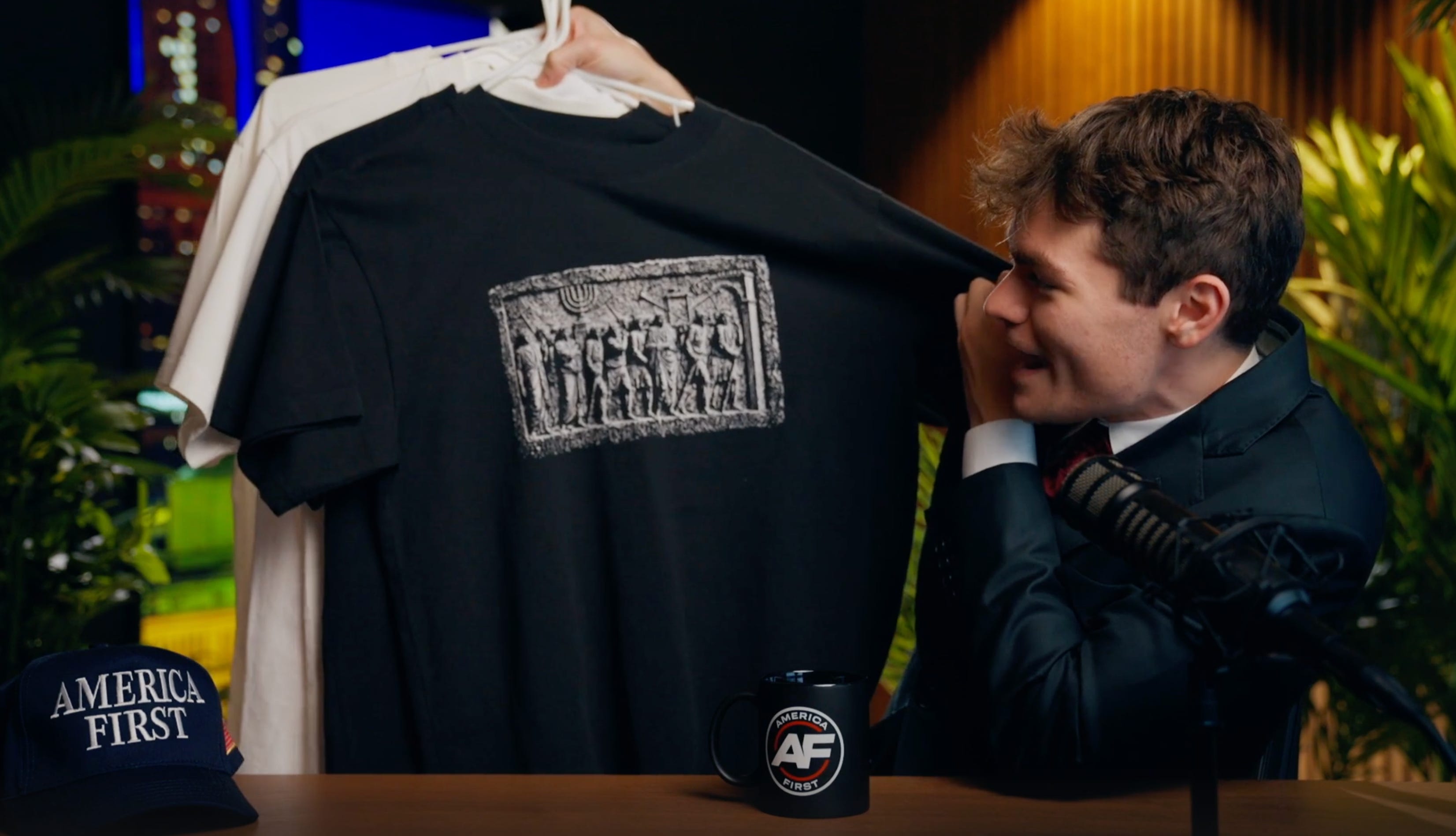
Nick Fuentes Shows Off His Arch Of Titus Merchandise
Perhaps the clearest window into what his many thousands of devoted followers think, are the superchats—the paid messages viewers send to get Fuentes to read. Watch any given episode and the volume of unprompted references to Jews (often coded as the 🧃 emoji, for “juice,” itself a play on “Jews”), and white supremacist ideology is staggering. That’s what the show is, at its core: Fuentes putting “America First” by fighting off the perceived threat of Zionist control.
And yet, Fuentes is not merely some raging neo-Nazi screaming into a camera. He is exceptionally smart, well-read, funny, and masterful on camera—he speaks fluently about Kabbalah, Tzimtzum, Jewish theology, history and philosophy. There is no one quite like him in American politics. He knows his audience cold, and he knows exactly how to blend humor with ideology in a way that placates his crowd while quietly growing his movement.
Unlike Tucker Carlson or Candace Owens, Fuentes won’t claim that Israel killed Charlie Kirk or blame Jews for everything under the sun. He presents himself as separate from the more unhinged antisemitism online, dismissing it as “low IQ antisemitism”—even as he claims Israel did 9/11 and that the Jews are at war with white Christian civilization.
And when he is joking, he says the n-word, mocks Jews, Black people, and Indians—he is transgressive in a way that feels thrilling to young men who harbor rage over political correctness, leftist ideology, and the sense that politics is controlled by hidden forces. He can give genuinely sophisticated—though of course fundamentally flawed—political analysis, and pivot to crude, gleeful transgression the next, and his audience loves him for both.
Some of his analysis, if you strip out the word “Jew” or “Zionist,” would read like relatively incisive and compelling political commentary. He remains a clear antisemite, and white supremacist, but he is also a rare talent, one who has figured out how to package that ideology for a mass audience of young conservatives hungry for something that feels transgressive, edgy, and intellectually serious all at once.
I think, therefore, that Fuentes is the most dangerous antisemite in America today. As Jeremy Boreing put it: “Almost certainly Nick Fuentes never gets elected dog catcher—or he’ll be the president.” While he has nowhere near the influence or power of someone like Zohran Mamdani, for example, Fuentes is attempting something deeply ambitious. He’s trying to take today's philosemitic Republican Party and reshape it from within. He is building a fast-growing and dedicated movement of young conservative American men, and it increasingly looks like he may be well on his way to remaking the conservative movement into one that is antisemitic and deeply racist.
There’s little doubt that Fuentes is seeking power: “It all means nothing if we don’t get our people in office, if we don’t get our people in government. That’s why I tell Groypers, ‘Don’t let them put your name on a list. Hide. Conceal your views. Your job is to get into the Ivy League; your job is to get into these offices and do what you need to do, say what you need to say.’”
Fuentes and the antisemitic joke culture are no longer merely confined to group chats and jokes between friends. They now have a harrowing political dimension.
Meet James Fishback: the first Groyper candidate. A political newcomer running to replace Ron DeSantis as governor of Florida, he has no chance of winning. But the energy behind him is a chilling sign of the growing political power of the antisemitic right. He's like the right's Zohran Mamdani—a TikTok-savvy, young insurgent promising to tear down the establishment—but Fishback's insurgency is fueled by a distinct type of transgressive antisemitism and racism.
Nick Fuentes hats are a fixture at his events. He sells shirts with the Groyper frog—the official logo of Fuentes’s movement—and shirts saying “I’m not going to die for Israel.” Fuentes supports him, and Fishback posts clips narrated by Fuentes to his social media accounts. He draws large crowds of young people who are genuinely energized—it is a real grassroots movement, almost Trump-esque in the tangible enthusiasm of his young supporters. And Fishback’s support doesn’t come only from Florida—the same young men everywhere who joke and believe in Jewish conspiracies, have become massive fans of his through social media.
Fishback has made contempt for Israel the centerpiece of his campaign. He uses the term “goyslop” at campaign events to massive applause—Fishback is the direct manifestation in electoral politics of the antisemitic meme culture I described above. The seething anger that drives his movement is not about Gaza or Palestinian rights though. It’s about sovereignty. Though he and his fans believe Israel is committing genocide, their main grievance is the belief that Israel controls America, that their politicians have been bought, that the country they love has been taken from them and handed to a foreign power. They are “America First and America only”—and in their worldview, those two things are inseparable from being opposed to the alleged Zionist control of our government.
Fishback constantly reminds audiences how much America spends on Israel while its own people struggle. He runs ads claiming criticism of Israel is being made illegal in Florida (it’s not). He calls Byron Donalds—his Black opponent—”AIPAC Shakur.” When he called Donalds a “slave to AIPAC” at a rally, the crowd erupted: “He is!” “Oh, yeah!” On Tucker Carlson’s show, he described the “sadistic” pleasure that pro-Israel donors get in forcing America to “bend over” for a foreign country. He refuses to say that 6 million Jews died in the Holocaust, and following an event he hosted at the University of Florida’s College Republicans chapter, the group was suspended after members performed Nazi salutes. Carlson, of course, endorsed Fishback: “Pretty soon, all winning Republican politicians will talk like this.”
One commentator noted:
“When I was standing among the crowds that came to see him, it was often when he brought up Israel that you could feel the energy pick up in the audience, that people would start cheering and applauding. I think that is at the core of his connection to some of these audiences.”
Fishback doesn’t only draw his support from hatred of Israel. He represents a growing discontent among young Republicans who feel betrayed by Trump—over the war with Iran and over the sense that he has done nothing to address affordability or make it possible to buy homes and start families. This same disillusionment is what has fueled the rise of Fuentes and others like him: the feeling that Trump’s anti-establishment MAGA image has turned out to be a façade, that he has simply joined the very establishment his movement was supposed to be rebelling against.
Fishback’s platform is also aligned with many of Fuentes’s grievances. He proposes a “sin tax” on OnlyFans “models,” a “mental-health czar” for purposeless men, fierce opposition to data centers, harsh stances on immigration, burning down abortion clinics, public hangings, and housing freed up by deportations. When young Americans feel buying a home is out of reach, he proposes funding a down payment assistance program by divesting the state from Israel bonds. In other words, Fishback is telling his supporters that the reason they cannot buy a home, cannot start a family, cannot build the life their parents had, is because their government chose Israel over them. His policies—a mélange of left-wing foreign and economic policy paired with a hard-right social stance—reflect a Tucker Carlson-esque worldview centered on a perceived war against the forces degrading American men and American culture. “This is a new party, not like the old America First. We’re becoming more extreme,” one of his fans explained. “Fishback is the first one to hold Nick Fuentes’s values—the first one trying to implement them.”
And of course, at his rallies, the antisemitic meme culture is omnipresent. “One hundred and nine countries couldn’t be wrong!”—a trope about the number of countries Jews supposedly have been expelled from. The crowd cheers. Later at that rally: “Six million! Was it really six million?”
And the polling confirms the increasing momentum of the Fuentes wing of the Republicans. Only 35% of extremely conservative young Americans agreed that Jews aren’t more loyal to Israel than America, that boycotting Jewish businesses is wrong, and that Jews don’t have too much power. Only half of young conservatives disagreed with all three. Most Republican men under 50 believe the Holocaust was exaggerated. Fishback is leading solidly among young Floridians.
Although Fishback and Fuentes are both nominally Republicans, both feel so betrayed by Trump’s Iran policy that Fuentes has gone so far as to explicitly tell his followers to vote Democrat. Fishback has echoed the same sense of rupture, saying he’d now grade Trump’s presidency a “C+” due to the War in Iran. One fan of both said that: “I think Joe Biden is preferable to Ben Shapiro. I think AOC is preferable to Ben Shapiro.” As Fuentes said on the 2026 midterms:
“I’m voting Democrat in 2026 because White people can play both sides too. The GOP broke every single promise: Epstein File coverup, regime change War in Iran, and no mass deportations. The GOP must be purged and burned to the ground in 26. Hostile takeover in 28.”
White supremacists who oppose abortion, gay rights, and immigration lining up behind AOC and the left—as the neo-Nazi Fuentes now advocates—is, on its face, incoherent. This shouldn’t be possible if this were an interests-driven worldview.
It isn’t. Fuentes’s movement is not a political program that happens to include antisemitism. It has one organizing idea, and he states it plainly: it is the white Christian war against the Jews—a single, perpetual conflict, theological and civilizational at once, running unbroken from Rome to the present, with the Groypers as its latest army. “We are Jacob, you are Esau,” Fuentes said. “We are the Church, you are the synagogue. We are Rome, you are Jerusalem.” He narrates in the first person—we sacked Jerusalem, we expelled the Jews from Spain—and by “we” he means white Christian civilization, of which he counts himself the modern protector. It sounds like Nazism because it is: his movement is defined in full opposition to Judaism. David Nirenberg, in Anti-Judaism: The Western Tradition, argues that anti-Judaism has functioned throughout Western history not merely as prejudice but as a tool of self-construction—people defining themselves against a projected idea of “the Jew” rather than holding a coherent set of beliefs that happens to include hostility toward Jews. Fuentes is doing exactly that, and it is why he can abandon every other value he holds and tell his followers to vote for AOC the moment Jews or Israel become the deciding factor.
But a war needs an enemy, so he invents one. It isn’t enough that the Jews did 9/11, he said—they laugh about it, they are proud of it, they did it in the open. It isn’t enough that they hold power—they have been using it, for two thousand years, to wage war on white civilization and on Christianity. Fuentes is the one waging a perpetual war against the Jews, so he has to project his war onto them, because only then does his own become defensive—and his war on the Jews becomes not evil, but the defense of white Christian civilization itself.
Rod Dreher, a conservative commentator, reported that between 30 and 40 percent of Gen Z Republican staffers in Washington are Groypers—followers of Nick Fuentes. One official told The New Yorker it was actually closer to 75 percent. “It’s now developed into something further than the Trump movement.” Another Trump staffer put it bluntly: “Radical Gen Zers have given up on Trump—and they’ll run the Party in twenty years.” At institutions like the College Republicans of America, Fuentes allies are gaining power and key roles.
As one Groyper put it: “Hide your true beliefs, gain power, gain influence, then, when the time is right, take power.” A Groyper from LA: “We’ll see an emergence of Groypers running the deep state, the private sector, and Congress.”
“Young people that would normally be run-of-the-mill conservatives are debating the Holocaust.” One political aide explained of the Fuentes acolytes: “They don’t have any demands. They just want to tear everything down.”
Thomas Massie—an anti-Israel Republican congressman who traffics in antisemitic conspiracy theories about the Epstein files, Israel, and AIPAC—won 75 percent of the youth vote in his Republican primary, running on opposition to the war in Iran. When he lost and conceded, he joked that his opponent was “in Tel Aviv.” At that rally stood a man wearing a hat styled just like Trump’s own, embroidered on the back the same way Trump’s are with his initials, “DJT.”
But this hat didn’t say DJT. Instead, it said NJF: Nicholas J. Fuentes.
This is a fascinating essay containing so much valuable and informative,although disturbing, information. In part 2, your thoughts regarding what ordinary American Jews, of different ages and generations, can do to effectively combat this growing antisemitism would be welcomed.
Karen Holzman
Extremely insightful article, thank you , keep up the good work!