

Antisemitism is a profound and growing danger to the Jewish People. As I’ll write in my next piece, from my experience as a high schooler, hatred of Jews is far worse among young people than most realize. Yet, since Oct. 7th, we have let antisemitism define this moment far more than we should. The Jewish people today are living through one of the greatest chapters in our four-thousand-year history, and—for the sake of our future—we must recognize and build on that.
This starts with a simple fact: the Jewish people have a state. Every Jew on earth has the ultimate assurance of safety, a place to return to. Throughout history, Jews have been victims, and often powerless ones. Ruth Wisse, a prominent scholar of Jewish History, called the loss of sovereignty “the defining political event in the life of the Jewish people.” That loss has been undone, and our sovereignty is a direct reversal of many of the tribulations that have defined Jewish history.
As a high schooler, the miracles of Jewish sovereignty and Zionism have always simply been there, almost facts of life. Most fundamentally, we must ensure this miracle is not taken for granted by the generation that inherits it most fully, and also the very generation whose Jewish identity is most under attack because of it. We must recognize that what is unprecedented about this moment is not the sickening antisemitism but the empowering shift in Jewish history away from victimhood and towards agency.
Having a state alone would make this the most optimistic era in Jewish history. But the Jewish state is among the most successful on the planet. Israel has one of the largest and most dynamic economies on the planet. Its air force, its intelligence services, its regional dominance, and its high-tech scene are among the best of any country, of any size. Crucially, since October 7th, Israel has supercharged its success. Threats on every front are being neutralized with striking effectiveness, the foundations for decades of security and prosperity are being laid, and even amid the war, Israel’s economy in 2025 ranked as the third-best performing in the world, according to The Economist. This immense economic and military success shows no signs of slowing down.
The post–Oct. 7 reality must be defined as laying the groundwork for a safer and more prosperous future for Israel and the Jewish people. We are at the beginning of what will be a Jewish renaissance, while the continuation of antisemitism remains unabated. Only one of those facts is truly special, truly worth defining a moment around.
And yet, our communal attention often flows the other way. Although I’m not suggesting we should ever be complacent in the face of a tidal wave of antisemitism, we often focus on it in unhealthy ways. Why have so many more Jews heard about the latest antisemitic incident than about the Muslim nation of Somaliland—where the Israeli flag is worn as a hijab in celebration—becoming an ally of Israel? Why do Jewish WhatsApp chats talk so much about the next hostile politician rather than Indian Prime Minister Modi’s profoundly moving address to the Israeli parliament? And why do so few Jews know about the deep wellspring of support for Israel and the Jewish People that exists across the world—in places like Nigeria, Kenya, and Uganda, where the defense minister offered to fight alongside Israel against Iran and built a statue honoring the fallen commando Yoni Netanyahu?
When Bret Stephens called for dismantling the ADL—the main player in the “fight against antisemitism”—at his State of World Jewery Address, he was both right and wrong. We need to fight antisemitism tooth and nail, and the ADL (sometimes) does important work. But he was right when saying that antisemitism is the one fight we cannot truly win. Faced with a hatred that is ancient and unrelenting, the Jewish community has understandably made fighting antisemitism central to its identity. But it’s in many ways a coping mechanism, not a strategy. Fighting antisemitism as a primary mode of Jewish expression means we have internalized the hatred—we have let it live rent-free at the center of our identity. We have also convinced ourselves that antisemitism can be defeated. It is instead a shapeshifting mind virus that has survived every attempt to stamp it out, and Jews have almost no control over.
Moreover, to define ourselves by hatred directed at us is to surrender what Viktor Frankl, writing from the depths of the Holocaust, identified as the last human freedom: the freedom to choose our response to our circumstances. Making Jewish optimism, Jewish peoplehood, and Jewish flourishing the center of what it means to be a modern Jew (and how we more effectively combat antisemitism, as Dara Horn has laid out) is both the prouder and the healthier path. And it is, in the end, what actually makes us safer. We cannot let an unwinnable battle become central to modern Jewish life when there are so many more positives to build on.
That’s why this Substack is called the Hill of Spring.
In 1909, a group of Jews facing antisemitism chose not to obsess over hatred, nor to build a bunker against it. They used their agency to build Jewish life, Jewish thriving, on their own terms. They gathered on a sand dune outside Jaffa and held a lottery. Each family drew a seashell to claim the plot of land where they would build their home. They chose to found a city—called Tel Aviv, Hebrew for Hill of Spring. The image that is the “logo” of this Substack is that moment: the founding of Tel Aviv. And no one needs to be told what the founding of Tel Aviv set in motion.
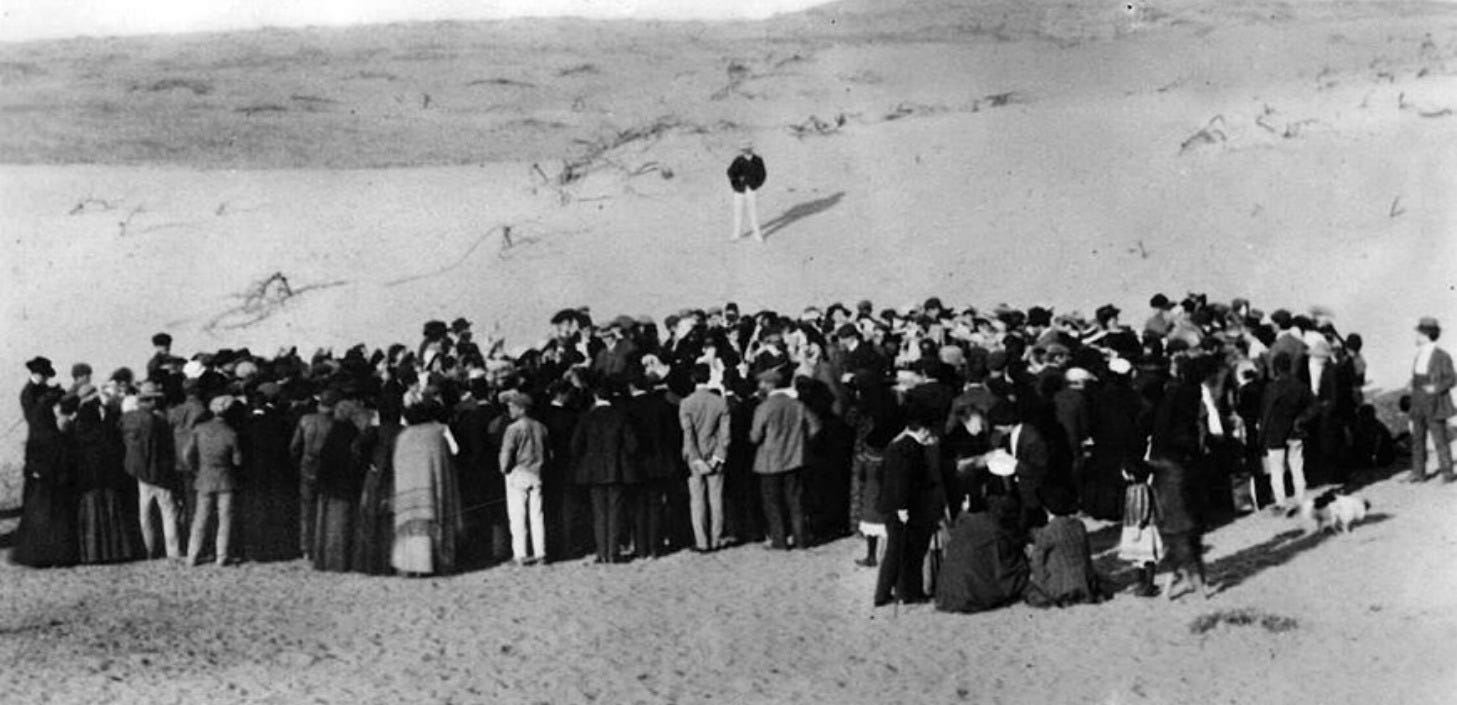
Tel Aviv’s name comes from the Hebrew translation of Theodore Herzl’s visionary novel Altneuland (“Old New Land”), itself inspired by the Book of Ezekiel. In that story, Jewish exiles sit by the river in Babylon, at a place called Tel Aviv, mourning exile and destruction. The name carries deep meaning: Tel means “mound”—the ruins of past civilizations—and Aviv means “spring”—new growth, renewal, beginning. It’s also no coincidence that the growth and flourishing of spring (aviv) are juxtaposed with death and ruins (tel).
Those sixty-six families audaciously chose to build Jewish flourishing as their answer to antisemitism. They built a city. That city became a country. That country is becoming the center of a remarkable era of safety and prosperity for the Jewish people.
We must embrace this spirit. We must make it our goal to build Hills of Spring anywhere, everywhere and in whatever form.
We have opportunities those sixty-six families holding seashells in 1909 could not have imagined. We owe it to them, and to ourselves, to build on them.
Wow!!
This is so Inspiring
Thank you!
Leo thx so much for this. I know you put a lot of thought and effort here and I've learned a lot from you about antisemitism. I also learned about the shells and the origin of our great city Tel Aviv in 1909. A great story. I can't wait to read what you have to say next.